

The Shifting Ground Beneath Somerville’s Creative Core
The Green Line Extension changed how Somerville connects to the wider Boston region. New stations improved access to jobs, schools, and commercial districts, but the same transit advantage also intensified pressure on land near former industrial buildings. Parcels that once supported workshops, small manufacturers, musicians, and artists began to look increasingly attractive to residential, office, and life sciences developers.
That pressure is especially visible around Joy Street and Somerville Avenue, where historic studio hubs sit beside a rapidly changing development market. Working artists often operate on month-to-month or otherwise vulnerable leases, while property owners face strong incentives to sell or redevelop. The result is a civic question with no simple answer: how can transit-oriented growth bring public benefits without removing the people and production spaces that give neighborhoods their character?
Somerville has confronted this conflict before. In 2013, Space Equals Work organized in response to rising rents, redevelopment threats, and proposed zoning changes affecting industrial buildings on Somerville Avenue. Its campaign helped persuade the city to abandon a proposal to rezone those buildings for residential use. That history established an important precedent. Physical space is not a secondary concern for artists. It is the foundation of their work, their income, and their contribution to public life.
The Green Line Ripple Effect and the Mechanics of Creative Displacement
Transit investment is often presented as an unqualified public good, and better transportation can indeed expand opportunity. Yet new rail access can also raise land values faster than existing tenants can adapt. Industrial properties near stations become attractive to developers seeking sites for apartments, laboratories, offices, and mixed-use projects. Even when a building remains standing, rising taxes, insurance premiums, utilities, and market rents can make continued occupancy impossible.
This pattern is not unique to Somerville. A review of research and policy literature, the Healthy Community Design, Anti-displacement, and Equity Strategies in the USA: A Scoping Review, identifies 141 anti-displacement strategies connected to transportation and other built-environment investments. The review emphasizes that improvements such as transit, parks, bike lanes, and mixed-use development can improve health and environmental conditions while also increasing property values and displacement risks. The lesson is direct: stabilization measures need to arrive before speculative pressure becomes irreversible.
Artists are particularly exposed because many leases do not reflect the long-term value of the work happening inside a building. A tenant may invest in equipment, soundproofing, ventilation, kilns, or safety improvements without receiving any ownership interest. If an industrial parcel is sold or rezoned, that investment can disappear with little warning. Traditional maker spaces also need characteristics that modern speculative offices rarely provide, including high ceilings, durable floors, loading access, robust electrical systems, ventilation, and tolerance for noise, dust, heat, or solvents.
- Transit access can increase the value of industrial parcels near stations.
- Short leases leave artists vulnerable to sudden rent increases, nonrenewal, or redevelopment.
- Specialized infrastructure makes relocation expensive and sometimes technically impractical.
- Cultural displacement affects not only tenants but also neighborhoods that rely on public studios, small businesses, and local events.
The experience of Space Equals Work showed why early organizing matters. Residents, artists, and small businesses used letters, public meetings, media attention, and direct conversations with officials to challenge a zoning proposal before it became permanent. That approach remains relevant as Somerville weighs how to capture the benefits of new transportation while protecting the working spaces that transit users may be trying to reach.
Decoding Somerville’s Zoning Overlays and Municipal Fabrication Safeguards
Somerville’s planning system attempts to shape what can be built and what kinds of uses can remain in areas undergoing change. Arts and creative-space requirements in mixed-use corridors can preserve a visible cultural presence, but the wording and implementation of those requirements matter. A developer may satisfy an arts provision with a polished gallery, lobby exhibition area, or small retail studio while offering nothing suitable for a sculptor, glass artist, printmaker, ceramicist, or furniture maker.
The city’s Planning, Preservation, and Zoning Division establishes regulatory parameters that can support fabrication districts and creative uses. Yet municipal enforcement operates within a difficult balance. Transit incentives encourage density, development can expand the tax base, and new construction may provide promised cultural amenities. At the same time, practical shop-floor requirements are easy to overlook when approvals focus primarily on square footage, use categories, and visual programming.
The distinction between display space and production space should be central to any overlay. A gallery can be open, clean, and publicly accessible without accommodating the machinery and environmental systems required for daily fabrication. Effective safeguards should address not only whether arts space exists, but also whether it is affordable, appropriately equipped, legally permitted, and available to working tenants for a meaningful period.
| Location or tool | Potential protection | Key enforcement question |
|---|---|---|
| Joy Street | Recognition of established studio clusters and creative production | Will protections cover active fabrication, not only public-facing exhibitions? |
| Brickbottom | Support for a concentrated community of artists and open-studio activity | Can affordability and building infrastructure be maintained as nearby land values rise? |
| Somerville Avenue | Industrial and maker-space safeguards shaped by earlier organizing | Will zoning prevent conversion of productive buildings into uses that exclude existing tenants? |
Regulation also has limits. A zoning overlay can restrict certain uses, require space, or preserve a district’s physical form, but it does not automatically make rents affordable. It may not provide capital for roof repairs, upgraded electrical systems, accessibility improvements, or insurance increases. Nor can a zoning text guarantee that a future owner will understand the difference between a flexible studio and a safe, legally compliant production facility. Those gaps explain why zoning is best understood as a first line of defense rather than a complete preservation strategy.
Beyond Private Leases with Community Land Trusts and Cooperative Ownership
The preservation of Central Street Studios offers a practical example of what can happen when organizing is connected to acquisition. After the owners announced plans to sell, tenants and supporters worked for more than four years to secure the 8,500-square-foot building. The Arts & Business Council of Greater Boston ultimately purchased it for $1.6 million, preserving approximately 25 artist workspaces. Somerville contributed $600,000, while private donations, grants, and loans supplied the balance. Tenants raised $65,000 through fundraisers and auctions, helping demonstrate both commitment and public support.
The property is protected by a land-restricted deed, and half of the studios are planned to have annual rent increases capped at 5 percent. That structure does more than delay displacement. It changes the ownership purpose of the building, making permanent artist workspace part of the property’s legal and financial identity. The outcome remains unusual, however, because it required patient sellers, substantial public and private capital, organized tenants, and a nonprofit capable of managing a complex real estate transaction.
The Art Stays Here Coalition has helped turn individual building fights into a regional conversation. Formed in 2022 after artists at Humphreys Street Studios faced a threatened sale, the coalition connects tenant associations, cultural organizations, funders, and advocates across Greater Boston. Its work includes support for the campaign to protect Somerville’s Fabrication District. Similar examples, including collective purchases in Dorchester and Fort Point, suggest that artists can be more than displaced occupants. With legal assistance and financing, they can become participants in ownership.
- Organize early. Tenants should form an association, document building conditions, understand lease terms, and identify allies before a sale is announced.
- Build a capital stack. Public funds, grants, donations, loans, and tenant fundraising can each fill a different gap in an acquisition budget.
- Choose a durable ownership model. A land-restricted nonprofit, community land trust, cooperative, or hybrid structure can prevent a future resale from undoing the preservation effort.
- Plan for governance. Successful ownership requires clear responsibilities for maintenance, rent setting, eligibility, conflict resolution, and long-term financial reserves.
Community land trusts and limited-equity cooperatives offer a useful framework for this work. A land trust can hold property for community benefit while a cooperative manages day-to-day occupancy and participation. Research on CLT and limited-equity cooperative models finds that collective ownership can reduce barriers to conventional financing, although physical, financial, and social feasibility must be carefully evaluated. The model is not a shortcut. It requires durable financing, member education, strong governance, and contingency planning for repairs and refinancing.
The contrast with zoning subsidies is significant. Zoning can require or encourage creative space, but acquisition removes a building from the most speculative part of the market. A subsidy may help a developer include studios in a project; a cooperative or land trust can ensure that the studios remain available even when market conditions change. The strongest civic strategy uses both: zoning to prevent immediate loss and community ownership to create permanence.
Inside the Studios of Joy Street and Brickbottom
At Joy Street Studios, Brickbottom, and The Loov, creative work takes place in a dense, visible network of rooms and shared infrastructure. The 2026 Somerville Open Studios program at Joy Street and The Loov includes artists working in sculpture, photography, glass, jewelry, printmaking, textiles, mixed media, drawing, fiber arts, and collage. Brickbottom and Joy Street Open Studios are scheduled for November 21 and 22, 2026, from noon to 5 p.m., giving the public an opportunity to see the spaces where work is made, meet artists, and understand the range of activity behind finished objects.
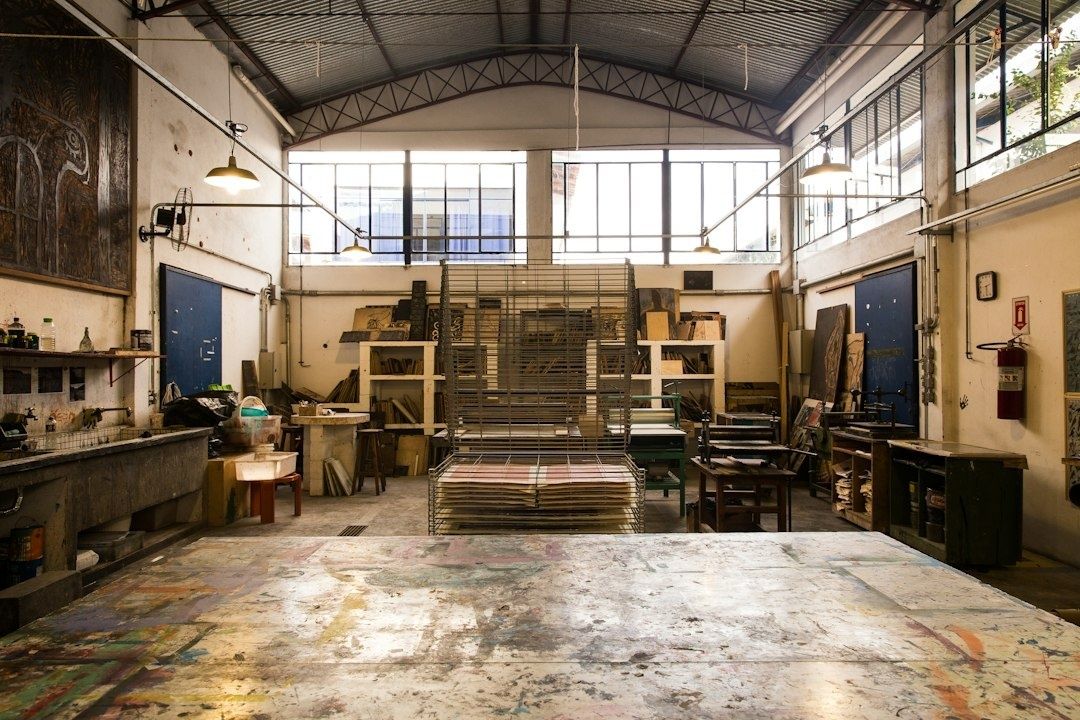
Open studios are cultural events, but they are also evidence of economic and civic value. Visitors buy work, discover local businesses, speak with neighbors, and see how production contributes to a neighborhood’s identity. The public visibility can strengthen preservation campaigns, yet visibility alone cannot pay rising operating costs. Artists still face higher utilities, insurance, materials, maintenance expenses, and compliance costs, often while living in a neighborhood where residential and commercial development is changing the customer base around them.
- Shared equipment such as kilns and spray booths can make otherwise unaffordable practices possible.
- Ventilation and electrical systems are often built into a specific property and costly to reproduce elsewhere.
- Loading and storage areas matter for materials, finished work, and large-scale fabrication.
- Peer networks provide informal technical knowledge, referrals, and mutual support that cannot be recreated simply by leasing isolated rooms.
Relocating these studios to outer suburbs would not be a neutral move. It could lengthen commutes, reduce public access, weaken sales, and separate artists from the networks that make their work sustainable. The presence of high-rises and new commercial buildings around older studio clusters makes the issue more visible, not less. The question is whether new development will treat existing production spaces as obstacles to be cleared or as civic infrastructure worth maintaining.
Building Permanence into Somerville’s Civic Blueprint
Zoning overlays can slow speculative conversion, protect industrial uses, and require developers to acknowledge the arts. They cannot, by themselves, guarantee affordable rent, finance major repairs, or prevent a building from being sold at the next market peak. Somerville’s long-term answer will require deed restrictions, community land trusts, limited-equity cooperatives, nonprofit acquisition funds, and public investment designed specifically for working studios.
That responsibility is shared. City officials can strengthen fabrication standards, monitor compliance, and direct preservation resources toward vulnerable buildings. Cultural organizations can provide technical assistance and help tenants navigate financing. Community trusts can hold property for public benefit. Residents can attend zoning and budget meetings, support local artists through purchases and open-studio visits, ask candidates about workspace preservation, and contribute to acquisition campaigns when buildings are at risk. Transit access and creative production should reinforce one another. A city that plans for both can grow without treating the people who make Somerville distinctive as temporary occupants.

Comments are closed.